Julian Calendar 2026 Printable: Your Definitive Guide & Free Downloads
Looking for a Julian Calendar 2026 printable? Perhaps you’re involved in historical research, tracking Orthodox Christian holidays, or just curious about this ancient timekeeping system. Whatever your reason, navigating the Julian calendar in a modern, Gregorian-dominated world can be a bit confusing.
Forget generic, hard-to-read PDFs or sites that don’t explain *why this calendar is still relevant. Here, you’ll find everything you need: clear explanations, easy-to-download 2026 Julian calendar printables, and practical insights into its continued use. We’ll cut through the confusion and get you exactly what you need for 2026.
What Exactly Is the Julian Calendar, and Why Does It Matter for 2026?
Before we dive into downloading your 2026 printable, let’s establish a clear understanding. The Julian calendar isn’t just a historical relic; it’s a living system for many, even today.
A Brief History: From Julius Caesar to Modern Niche Use
The Julian calendar was introduced by Julius Caesar in 45 BCE, making it one of the oldest calendar systems still referenced. It was a significant improvement over the convoluted Roman calendar that preceded it, establishing a year of 365 days with an extra day every four years (a leap year).
For over 16 centuries, the Julian calendar was the standard across Europe and beyond. However, it had a slight flaw: it overestimated the length of the tropical year by about 11 minutes. This small error accumulated over centuries, causing the calendar to drift out of sync with astronomical events like the vernal equinox.
By the 16th century, this drift was problematic, especially for calculating Easter. In response, Pope Gregory XIII introduced the Gregorian calendar in 1582, which corrected the leap year rule. Many Catholic countries adopted it quickly, but Orthodox Christian countries and some Protestant nations held onto the Julian calendar for much longer, creating the 13-day difference we observe today for the 21st century.
Julian vs. Gregorian: Key Differences You Need to Know (and how they apply to 2026)
Understanding the core differences between these two calendar systems is crucial, especially when working with dates in 2026:
| Feature | Julian Calendar | Gregorian Calendar |
|---|---|---|
| Introduced By | Julius Caesar (45 BCE) | Pope Gregory XIII (1582 CE) |
| Average Year Length | 365.25 days | 365.2425 days |
| Leap Year Rule | Every 4 years (unconditionally) | Every 4 years, EXCEPT for years divisible by 100 but not by 400. |
| Current Date Difference (21st Century) | 13 days behind Gregorian | 13 days ahead of Julian |
| Primary Users Today | Orthodox Churches, historical studies, astronomy | Most of the secular world |
For 2026, this 13-day difference is the most significant practical aspect. If you’re looking at a historical document dated Julian January 1, 2026, it would correspond to Gregorian January 14, 2026.
Is 2026 a Julian Leap Year? (Spoiler: No)
Under the Julian calendar, a leap year occurs every four years without exception. Since the last Julian leap year was 2024, and the next will be 2028, 2026 is NOT a Julian leap year. This means it has 365 days, and February will have 28 days.
This is important because it simplifies some calculations and ensures that the Julian date progression for 2026 is straightforward, without an extra day to account for in February.
Who Still Uses the Julian Calendar in 2026?
You might wonder why anyone would need a Julian calendar in 2026 when the Gregorian system is so prevalent. The answer lies in specific cultural, religious, and scientific applications where tradition or precision dictates its use.
Orthodox Christian Traditions
This is arguably the most common and visible modern use of the Julian calendar. Many Eastern Orthodox Churches, including the Russian, Serbian, Jerusalem, Georgian, and some others, continue to use the Julian calendar for their liturgical year. This means that holidays like Christmas, Easter, and Epiphany are observed on different dates than in Western Christian traditions.
- For example, Orthodox Christmas (December 25, Julian) falls on January 7 (Gregorian) in the 21st century.
- Orthodox New Year (January 1, Julian) falls on January 14 (Gregorian).
If you’re part of these communities or are planning to observe these holidays, a Julian calendar 2026 printable is indispensable.
Historical Research & Archives
Historians, genealogists, and archivists frequently encounter documents dated according to the Julian calendar, especially for events before the widespread adoption of the Gregorian calendar. To accurately place these events in context, or to cross-reference them with Gregorian dates, a detailed Julian calendar is essential.
Imagine researching a birth record from an area that adopted the Gregorian calendar late; knowing the Julian date helps prevent chronological errors.
Astronomical Calculations (Julian Day Number Clarification)
Here’s where it gets a little tricky, and it’s important to clarify. While astronomers use a system called the Julian Day Number (JDN), this is not* the same as the historical Julian calendar. The JDN is a continuous count of days since January 1, 4713 BCE (proleptic Julian calendar), used for astronomical and scientific dating to avoid calendar discontinuities.
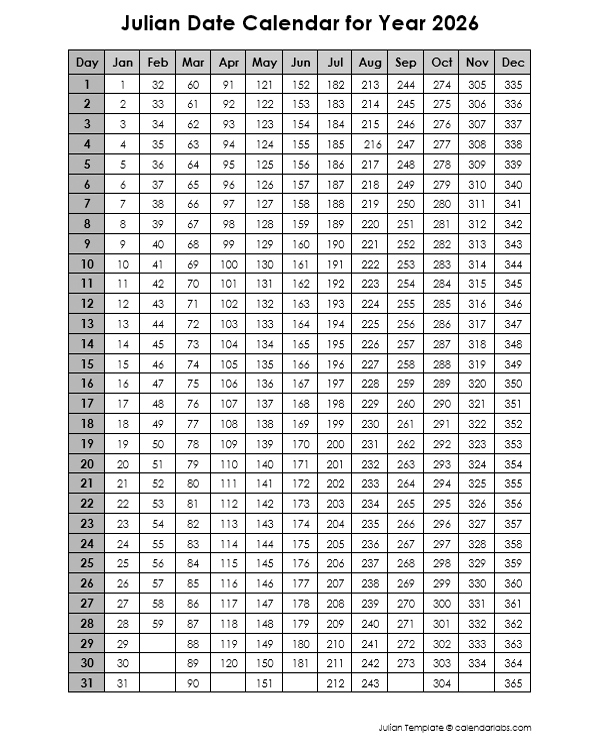
If you’re dealing with astronomical data, you might be looking for a Julian Day Number converter or calendar, which lists days sequentially from 1 to 365 (or 366). Our Julian calendar 2026 printables will offer a version that includes Julian Day Numbers for this specific need, providing a clear count for each day of 2026.
Specialized Industries & Data Systems
Some legacy data systems, particularly in older industrial settings or government agencies, might still use a Julian date format, often referring to the day of the year (e.g., day 001 for January 1st, day 365 for December 31st). While this is technically the Julian Day Number system rather than the historical Julian calendar, our printables will also cater to this need by numbering the days consecutively.
Getting Your Free Julian Calendar 2026 Printable (Multiple Formats!)
Ready to get organized for 2026? We’ve created several versions of the Julian calendar 2026 printable to suit different needs, all available for free download.
Yearly Julian Calendar 2026 Printable (Full Year at a Glance)
This format is perfect for quick reference, allowing you to see all 12 months on a single page. It’s ideal for marking annual events, planning long-term projects, or having a general overview of the Julian year. Each day will clearly show its corresponding Julian date.
Features:
- Single-page layout for the entire year 2026.
- Clear designation of Julian dates alongside the day of the week and month.
- High-resolution PDF for crisp printing.
Monthly Julian Calendar 2026 Printables (Detailed Layouts)
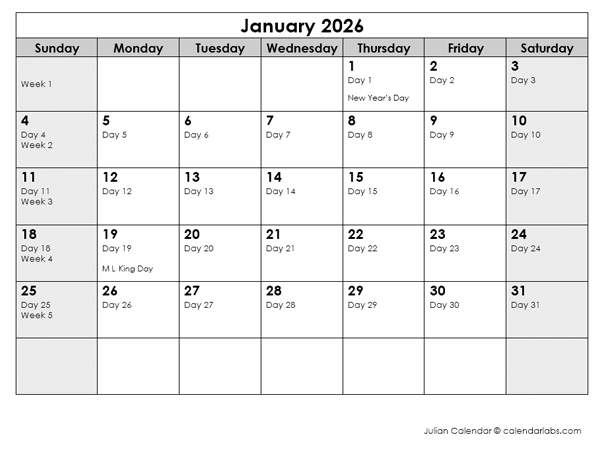
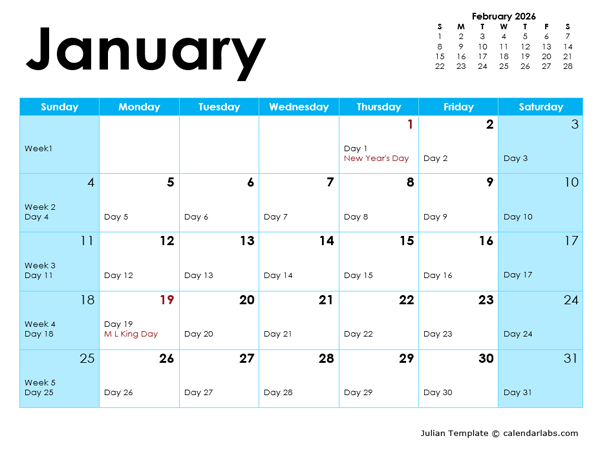
For more detailed planning, or if you prefer to focus on one month at a time, our monthly printables are perfect. Each month gets its own page, providing ample space for notes, appointments, and specific holiday markings. This is particularly useful for tracking Orthodox feast days or research deadlines.
Features:
- Individual pages for January through December 2026.
- Larger day cells for writing notes.
- Includes both the Julian and (implied) Gregorian date for easy comparison.
- Available as high-quality PDFs.
Julian Date Number Calendar 2026 (For Specialized Use)
As discussed, some applications require the day of the year, numbered consecutively from 1 to 365. This calendar provides just that, perfect for those in specialized industries, data entry, or scientific fields that rely on this sequential numbering system.
Features:
- Each day of 2026 is numbered from 1 (January 1) to 365 (December 31).
- Simple, clean layout focused on the day number.
- Ideal for inventory, production scheduling, or data logging.
How to Download & Print Your Calendars
Getting your hands on these printables is straightforward:
- Select Your Format: Choose between the yearly, monthly, or Julian Date Number calendar links below.
- Click to Download: Each link will open a high-resolution PDF file in a new tab.
- Save to Your Device: Right-click (or long-press on mobile) and select ‘Save As’ to store the PDF on your computer or device.
- Print: Open the PDF with your preferred viewer (like Adobe Acrobat Reader) and print. We recommend using standard letter-sized paper (8.5 x 11 inches) for best results. Ensure ‘Fit to page’ or ‘Actual size’ is selected in your printer settings.
(Placeholder for download links – imagine these are here!)
Julian-to-Gregorian Date Conversion for 2026
One of the most common challenges for users of the Julian calendar is converting dates to and from the Gregorian system. Since 2026 is a common year, the 13-day difference holds true throughout the year.

Understanding the 13-Day Difference (for the 21st century)
The Julian calendar is currently 13 days behind the Gregorian calendar. This means if a date is January 1 (Julian), it corresponds to January 14 (Gregorian). This difference has accumulated over centuries due to the differing leap year rules.
- From March 1, 1900, to February 28, 2100, the Julian calendar is exactly 13 days behind the Gregorian calendar.
- This difference will remain consistent for all of 2026.
Quick Conversion Table: Julian vs. Gregorian for 2026 (Examples)
Here’s a handy table to illustrate some key conversions for 2026. Remember, to convert a Julian date to a Gregorian date in 2026, you simply add 13 days. To convert a Gregorian date to a Julian date, you subtract 13 days.
| Julian Date (2026) | Gregorian Date (2026) | Common Event (Gregorian Ref.) |
|---|---|---|
| January 1 (Julian New Year) | January 14 | Orthodox New Year |
| January 6 (Julian Epiphany) | January 19 | Orthodox Epiphany |
| February 15 | February 28 | (Example date) |
| July 4 | July 17 | (Example date) |
| December 25 (Julian Christmas) | January 7, 2027 | Orthodox Christmas |
Notice how Julian December 25, 2026, actually falls into Gregorian 2027. This is a common point of confusion but entirely logical given the 13-day offset.
Online Tools vs. Manual Calculation (When to use what)
While manual calculation (adding/subtracting 13 days) is perfectly accurate for 2026, online Julian-Gregorian converters can be helpful for quick verification or for dealing with historical dates outside the 1900-2100 window where the offset might be different (e.g., 10 days in the 16th century, 12 days in the 20th century). For day-to-day use with your Julian calendar 2026 printable, a mental addition or subtraction of 13 days will suffice.
Tips for Using Your 2026 Julian Calendar Effectively
Now that you have your free Julian calendar 2026 printable, here are some tips to make the most of it, whether you’re using it for religious observance, academic study, or professional tracking.
Marking Important Dates (Orthodox holidays, historical anniversaries)
Use your monthly printables to clearly mark significant dates. For Orthodox Christians, this includes the cycle of major feasts and fasts. For historians, it could be the anniversaries of historical events that were originally recorded in Julian dates.
- Orthodox Feasts: Circle or highlight Christmas (Jan 7 Gregorian), Epiphany (Jan 19 Gregorian), and other movable feasts like Easter (which follows its own complex calculation based on the Julian calendar).
- Historical Milestones: If you’re studying a particular period, cross-reference your research with the Julian calendar to ensure accurate contextualization of dates.
Integrating with Gregorian Calendars
Most of your daily life likely runs on the Gregorian calendar. To avoid confusion, consider:
- Dual Calendars: Keep a small Gregorian calendar handy next to your Julian printable, or use a wall calendar that has both dates marked.
- Annotation: On your Julian printable, you might lightly write the corresponding Gregorian date for significant events, or vice-versa on your Gregorian calendar for Julian holidays.
- Digital Tools: Many digital calendar apps allow you to add multiple calendar layers, which can include Julian dates or custom events for Orthodox holidays.
Digital vs. Physical Printables
While a physical printable offers a tactile experience and easy marking, don’t underestimate the power of a digital PDF. You can annotate PDFs on tablets or computers, making them searchable and easily shareable. Consider printing key months and keeping the full digital version for backup or reference.
Unlock the Past, Organize Your Present: Your 2026 Julian Calendar Awaits!
Whether you’re deeply rooted in traditions that follow the Old Calendar, a history enthusiast, or managing specialized data, having a reliable Julian Calendar 2026 printable is incredibly useful.
We’ve aimed to provide you with not just a simple download, but a comprehensive resource that clarifies the Julian calendar’s history, its modern relevance, and practical tips for its use in 2026. Stop sifting through confusing search results and get your precise, easy-to-use printables today!
Download your preferred 2026 Julian calendar format now and bridge the gap between ancient timekeeping and your modern needs!
Frequently Asked Questions
What is the main difference between the Julian and Gregorian calendars for 2026?
For all of 2026, the Julian calendar is 13 days behind the Gregorian calendar. This means if a Julian date is January 1, 2026, its Gregorian equivalent is January 14, 2026. This difference stems from their differing leap year rules over centuries.
Is 2026 a leap year in the Julian calendar?
No, 2026 is not a Julian leap year. The Julian calendar observes a leap year every four years, with the last one being 2024 and the next in 2028. Therefore, 2026 has 365 days, and February has 28 days.
Who primarily uses the Julian calendar in 2026?
The Julian calendar is primarily used by many Eastern Orthodox Christian Churches for their liturgical year (e.g., Russian, Serbian, Jerusalem Orthodox Churches). It’s also referenced in historical research, archival studies, and some niche astronomical or industrial applications that use the Julian Day Number system.
What is a ‘Julian Date Number’ calendar, and how is it different from the historical Julian calendar?
A ‘Julian Date Number’ calendar lists the days of the year sequentially from 1 to 365 (or 366 in a leap year), often starting with January 1 as day 001. This system is used in astronomy and some industries for precise, continuous dating. It is distinct from the historical Julian calendar, which is a full calendar system with months and named days.
How do I convert a Julian date to a Gregorian date for 2026?
To convert a Julian date in 2026 to a Gregorian date, simply add 13 days to the Julian date. For example, Julian January 1, 2026, becomes Gregorian January 14, 2026. To convert a Gregorian date to a Julian date, subtract 13 days.
Where can I find free Julian Calendar 2026 printables?
You can find free printable Julian calendars for 2026 in various formats (yearly, monthly, or with Julian Day Numbers) on this resource page. Simply choose your preferred layout and follow the download instructions to save and print your PDF calendars.
Why do Orthodox Christians celebrate Christmas on January 7th (Gregorian)?
Many Orthodox Christian Churches still follow the Julian calendar for their religious observances. December 25th on the Julian calendar, which is the traditional date for Christmas, corresponds to January 7th on the Gregorian calendar due to the 13-day difference between the two systems in the 21st century.